A digital twin, built from the data you already have.
A closed-loop simulator of your machine, its controller, and the outcome, so you can test a process change before it ever touches production.
What it is, and what it isn’t
It isn’t a CAD model, a 3D animation, or a dashboard. It’s a behavioral simulator: give it a proposed change and it predicts how the machine, the controller, and the part will respond, second by second, closing the loop the way your real line does. And it’s built entirely from the sensor history you already collect, with no new sensors and no production downtime.
The problem it solves
You suspect a change would help: re-tune the control logic, ease a feed, widen a window. But you can’t safely experiment on production parts. Every trial risks scrap, and a single cut rarely tells you anything. A twin gives you somewhere to run thousands of counterfactual cuts offline, compare candidate policies head to head on the same cuts, and carry only the winner to the floor.
The controller, running a cut inside the twin.
This is the twin’s closed loop in motion, on a loop. On the left, today’s over-cautious control brakes to a crawl in the deep zone and stays there, so erosion piles up. On the right, the twin’s eased policy keeps the feed up where there is headroom, so it erodes far less and finishes the cut sooner, at the same safe cutting force. Hit Pause to stop, or drag the handle to scrub through the cut.
Index: today = 100. Erosion is full-cut wear; deep-zone time is time spent in the deepest part of the cut. The blue cutting force stays well under its hard limit in both runs (it peaks near half of it), so the crawl was never about cutting force.
Illustrative closed-loop model, decoupled from any client data and shown only in relative terms (today = 100): the eased policy models about 60% less wear and about 44% less time in the deepest part of the cut, while staying under the hard limit on every step. Numbers are modeled, not a live machine.
How it’s built: four models in a loop
We don’t hand-write physics from scratch. We reconstruct your process as four small models, each fit to your own data, then step them together so the twin both replays real history and answers “what if we had done it differently.”
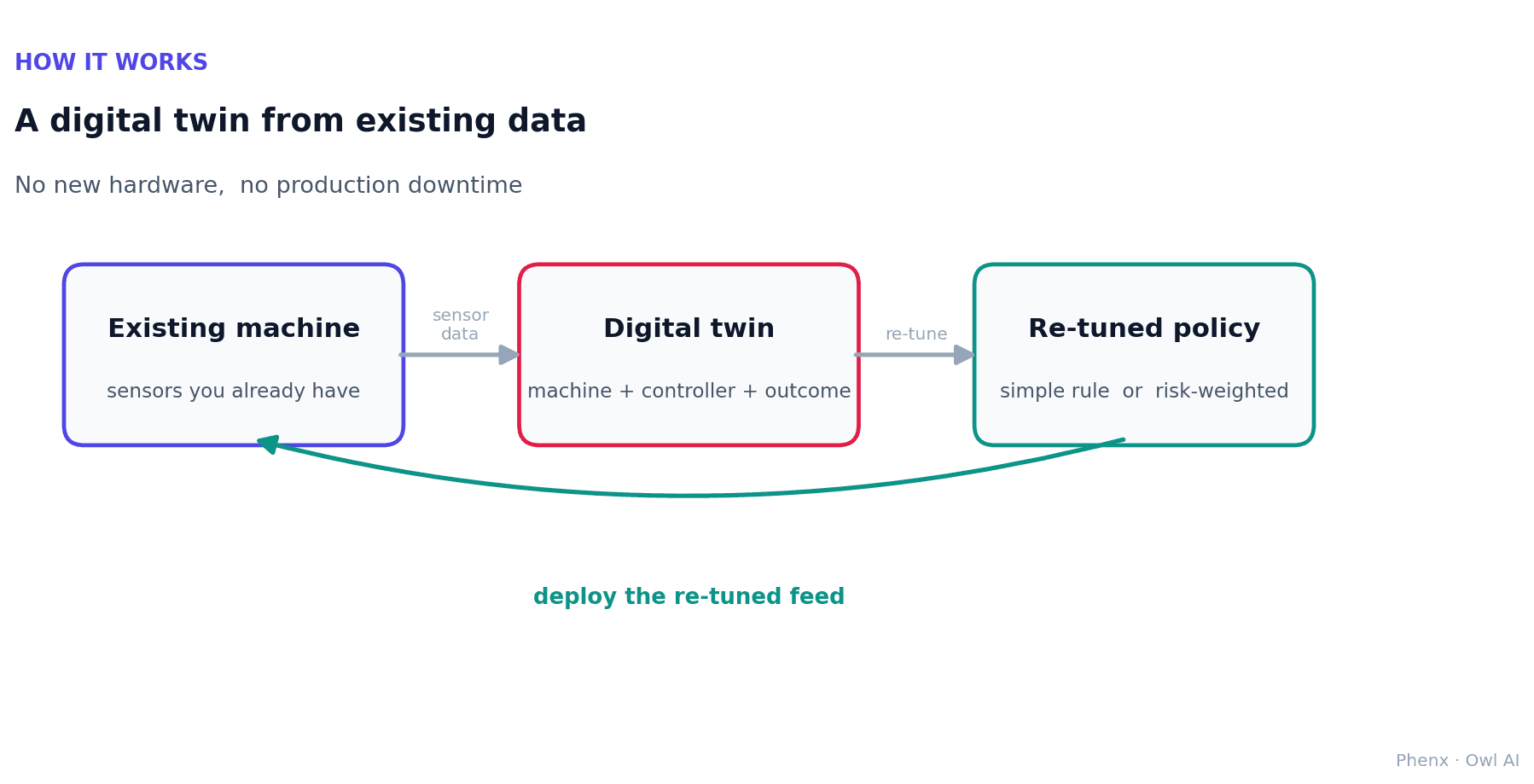
- State. Where the process is right now (how far through the cut, the pass, the cycle) and how each move advances it.
- The plant. How the machine physically responds: the forces, heat, and wear it produces. We build this grey-box, so physics fixes the direction (slower feed means more rubbing) and your data fixes the magnitude.
- The controller. Your existing control logic, recovered from the logs by system identification, so the twin reacts exactly the way your line does today.
- The outcome. What actually makes a part pass or fail (often accumulated contact, not the peak force everyone watches), calibrated against your inspection history.
These four step together once per tick. Because the loop is closed, the twin reproduces your real runs faithfully first, which is what earns the right to trust its counterfactuals.
What you can do with it
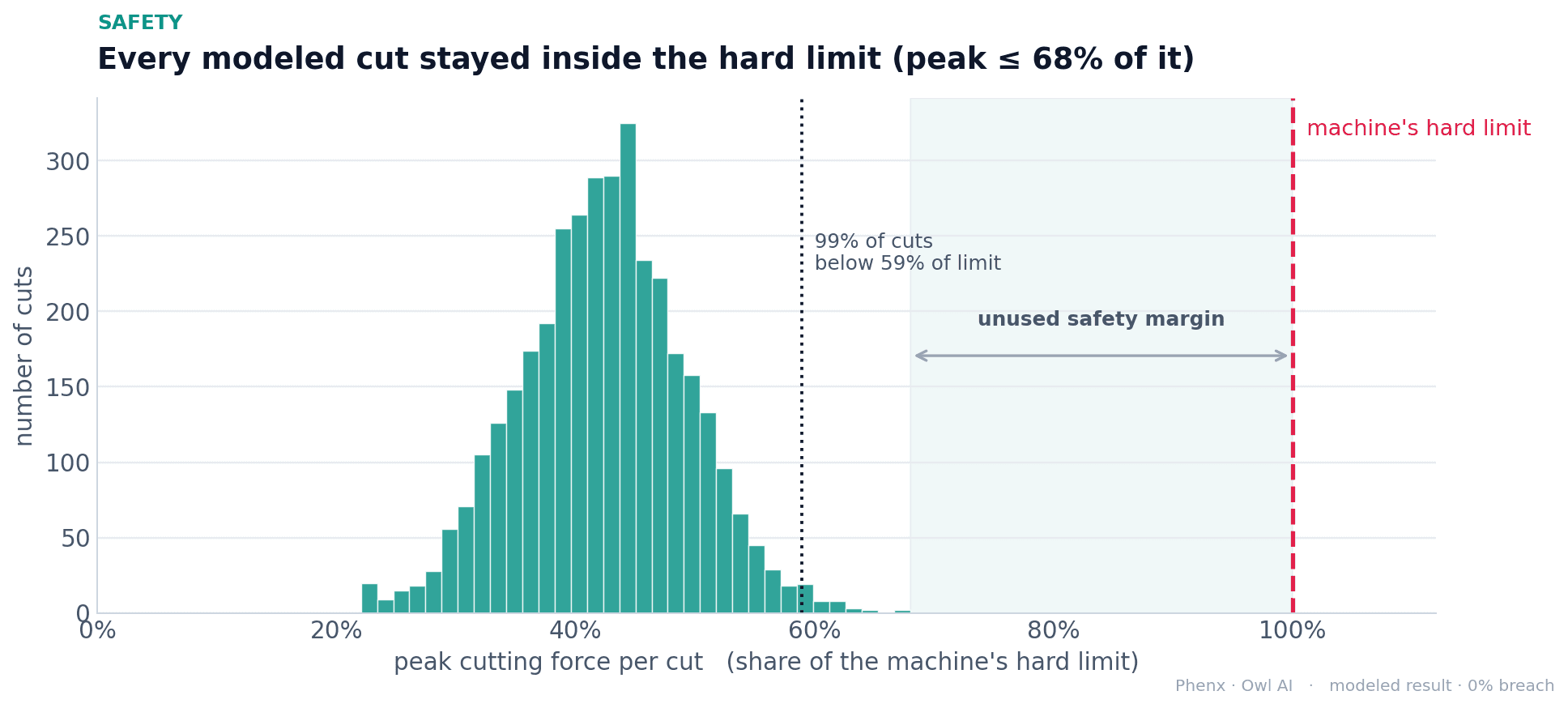
- Re-tune a control policy and prove it’s safe before deployment, with a hard-limit safety override checked on every simulated cut.
- Compare candidate changes head to head on the same cuts, instead of one risky trial at a time.
- Size and de-risk a live trial: pick the highest-leverage cuts and power the sample before you touch a single production part.
- Separate a real effect from noise by replaying history, so you know the twin agrees with your machine before you ask it anything new.
It also simulates the cut time
Because the twin steps each cut forward one tick at a time, it doesn’t only score safety and wear, it also predicts how long the cut takes. When the eased policy runs the same depth at a higher feed, it simply finishes in fewer ticks. That makes the cut-time result kinematic: it holds whether or not you accept the failure model, because it’s just less time spent at low speed.
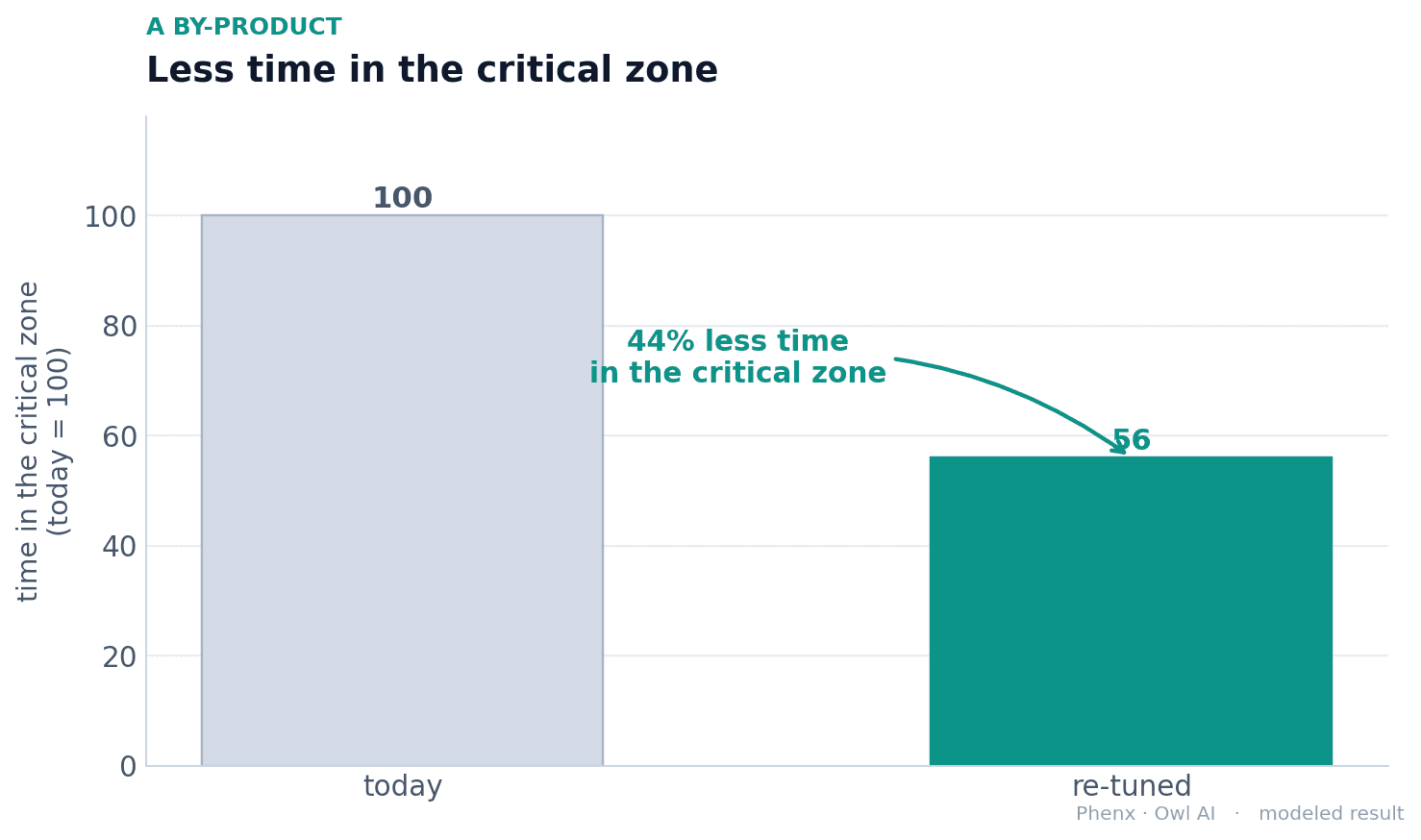
Across the cuts the policy touches, the twin modeled 94% of cuts faster and 0% slower (the supervisor only ever raises feed, so it can’t slow a cut down), with the deep-zone feed easing from about 6 to about 9. Cohort-wide that recovered on the order of 78 machine-hours: capacity that comes free alongside the quality gain, on the very same cuts.
Worked proof: a precision machining line
The cut-time numbers above come from this same engagement. On a precision machining line, we built a twin from existing logs and used it to test an eased control policy against the one running today. On quality and safety, it modeled up to ~60% less sidewall wear and stayed inside the machine’s hard force limit on every cut, peaking at ≤ ~68% of it (0% breach).
What we don’t hand-wave
These are modeled results, and we label them so. The same twin that produces the projection also defines the live, on-machine test that confirms it before anything ships. We separate what’s proven from what’s projected, every time.
Have years of machine logs and a change you’re afraid to test?
That’s exactly what a twin is for. Let’s build one from your data.