The controller was causing the defect it was trying to prevent.
On a precision machining line, an adaptive feed control was slowing the tool to protect each part, and the data told a different story.
The challenge
A precision manufacturer was losing high-value parts to sidewall defects: scrap and rework on a cut that has to come out right the first time. The machine already ran an adaptive feed control that slows the tool whenever cutting forces rise, on the assumption that slower is safer.
What the data revealed
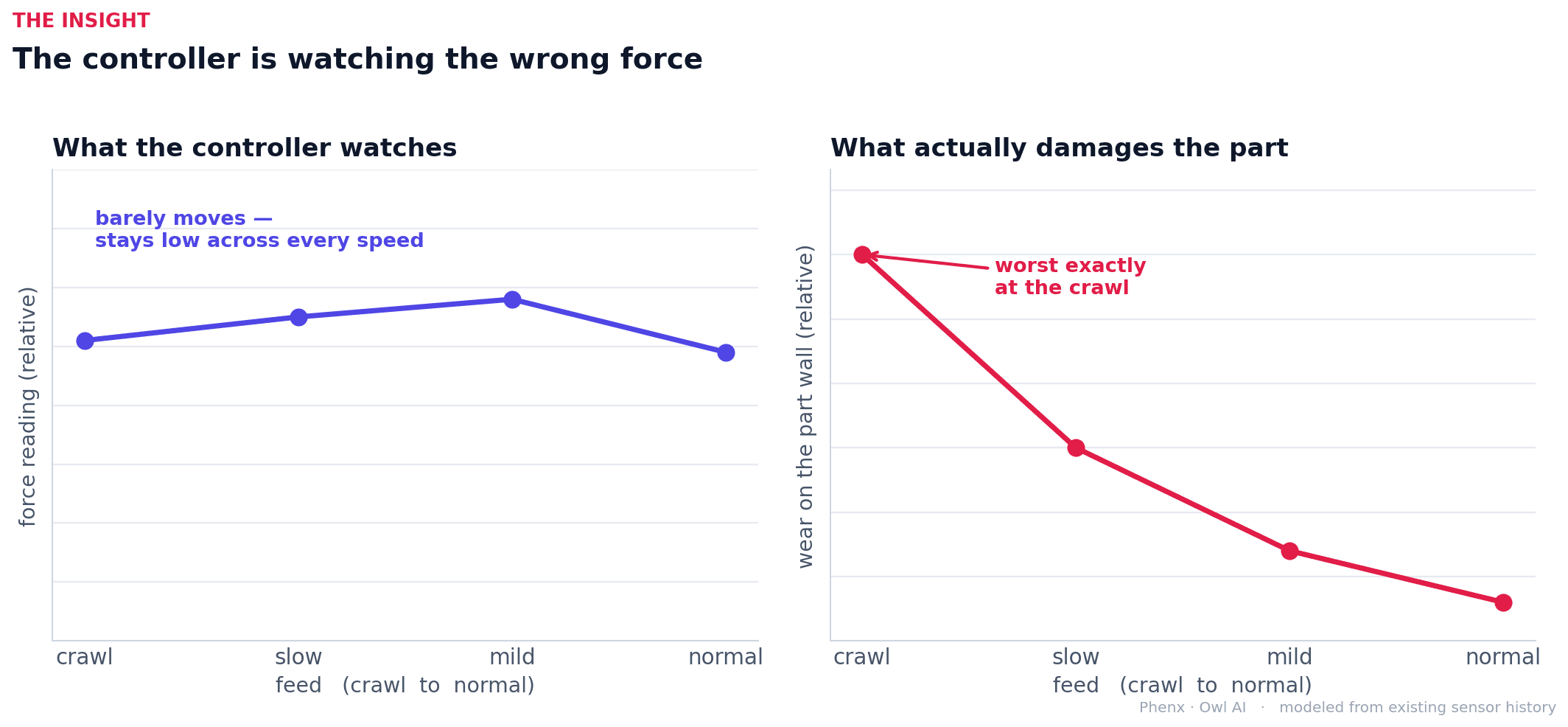
It wasn’t. Reading the machine’s own sensor streams, Owl AI found the controller was dramatically over-cautious: in more than 90% of its slowdowns the force never came close to the machine’s safety limit. Worse, the prolonged slow cutting was itself eroding the sidewall. In this data, sidewall load during the crawl ran roughly 10× higher than at a normal feed. The logic meant to protect the part was quietly degrading it: a pattern invisible in any single cut, but unmistakable across millions of seconds of data.
What we built
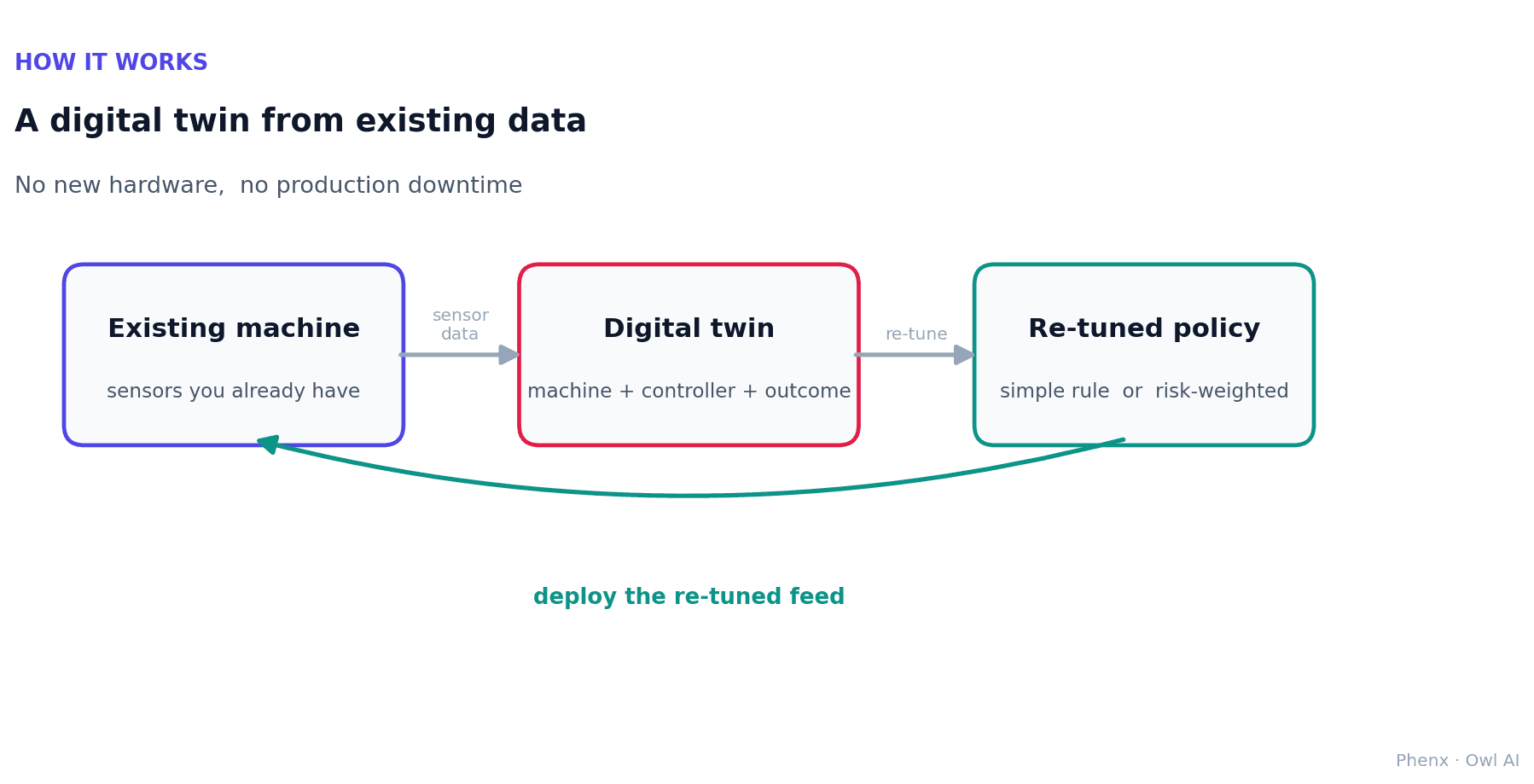
From that historical data alone, with no new sensors and no production downtime, we built a digital twin: a closed-loop simulator of the machine, its controller, and the cut outcome. Against that twin we tested a re-tuned control policy in two forms: a simple rule any PLC can run, and an ML risk-weighted version for finer targeting. The simple rule captured nearly all of the benefit.
The results, in simulation
- Up to ~60% less sidewall wear on the modeled cuts.
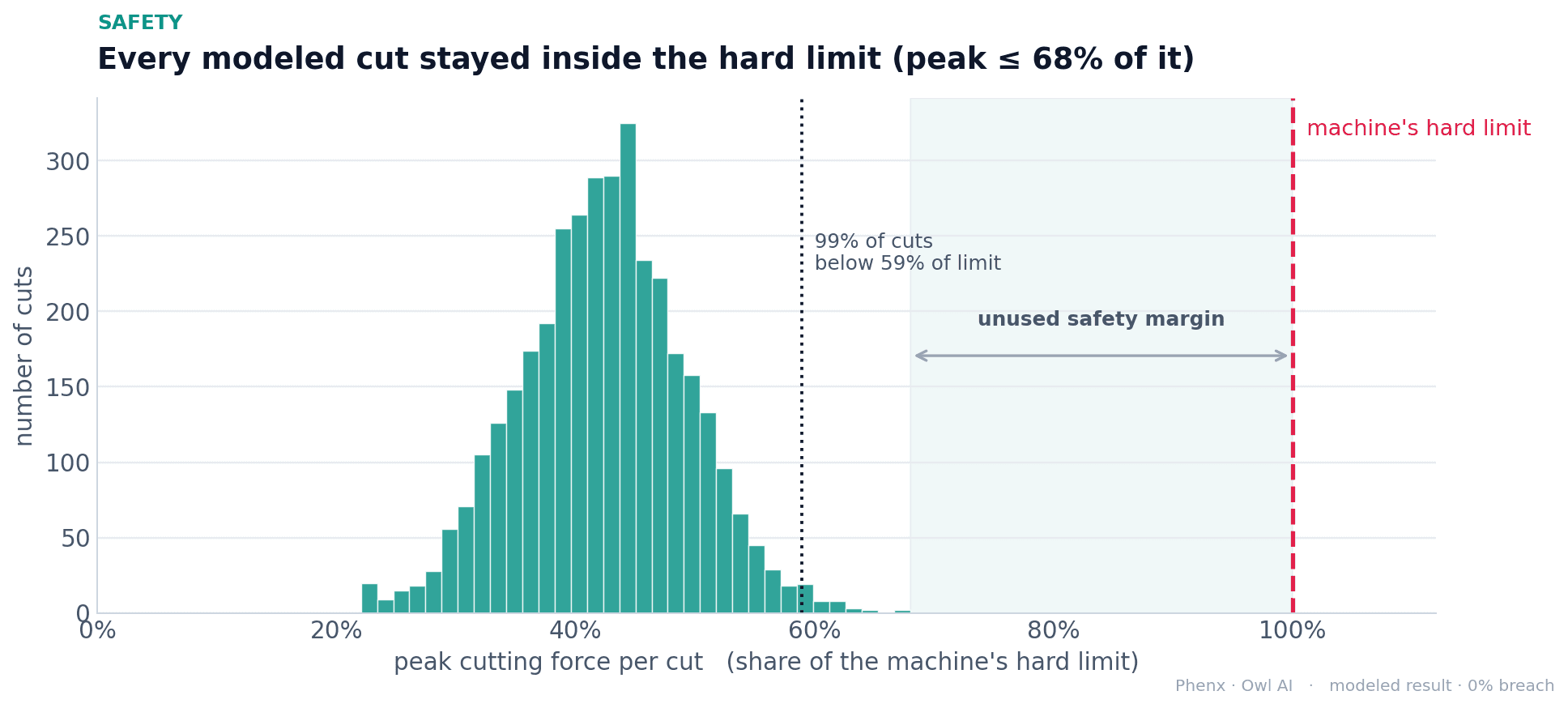
- Stayed within the machine’s hard force limit on every modeled cut, peaking at ≤ ~68% of it (0% breach).
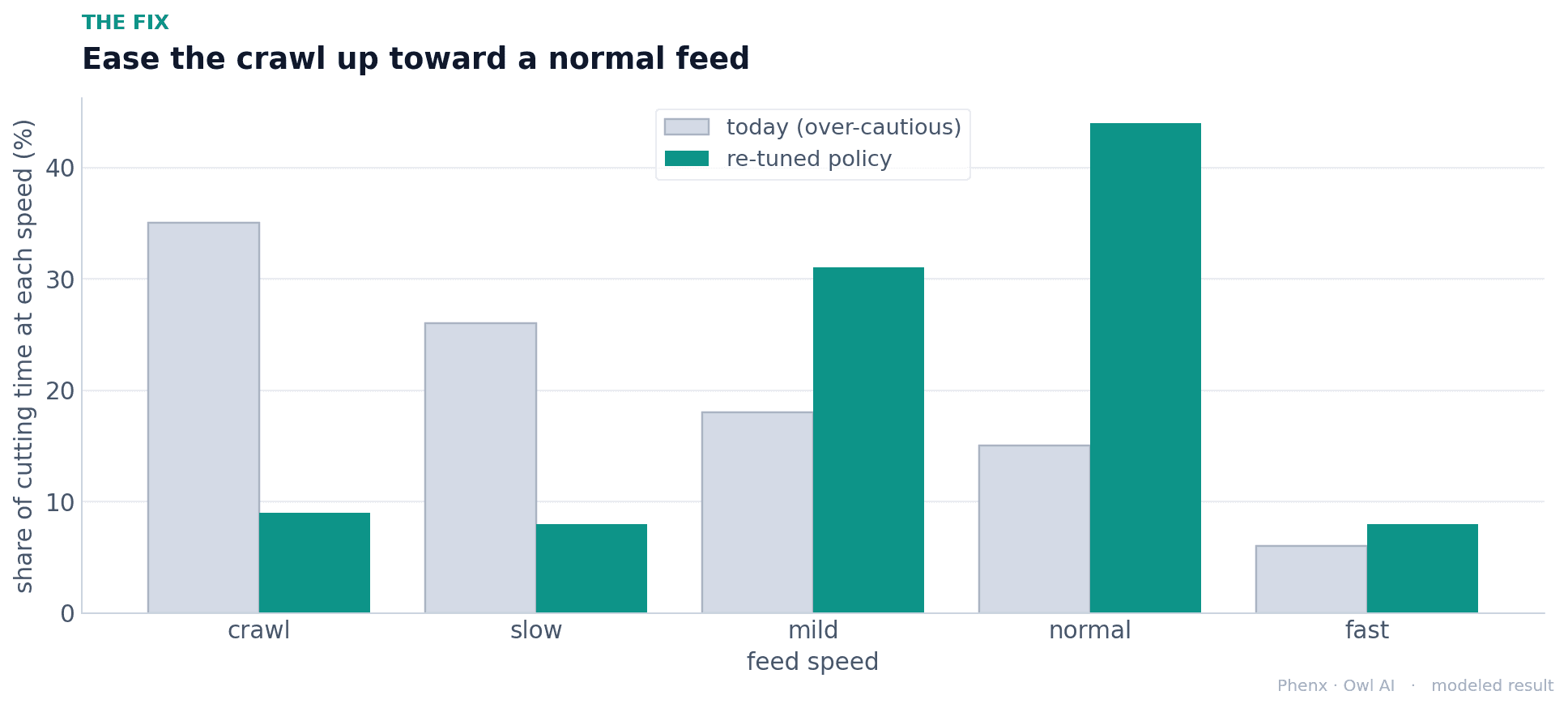
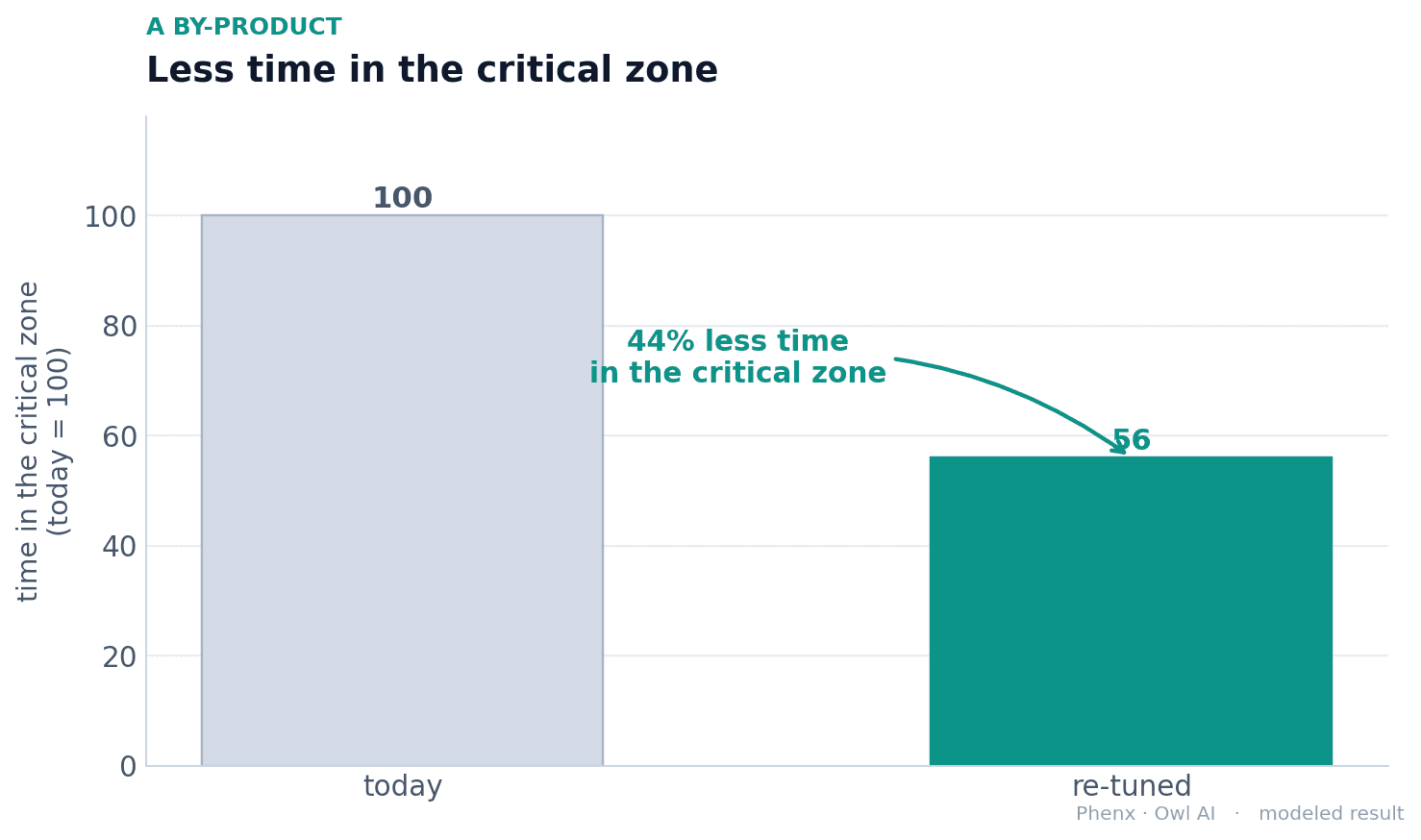
- On the cuts the policy acts on, ~44% less time in the deepest part of the cut, recovering capacity as a by-product (mean feed eased from ~6 to ~9).
What we don’t hand-wave
These are modeled results, and we say so. The same digital twin defines a live, on-machine validation step that confirms the gains before anything ships to production. We separate what’s proven from what’s projected, every time.