Why construction estimates lose their margin after the bid is won
The markup survives the sale. Labor, rework, and job mix do not.

Ask a contractor where the margin went and you will get a job story. The GC dragged the schedule. The crew was green. The submittal came back twice. All of it is true, and none of it explains why the answer comes out the same way on job after job, for years.
The markup is the only part of an estimate that survives the sale intact. It is a decision, written down once, applied every time. Everything underneath it is a forecast: crew hours, production rates, how much of the work gets done twice. Those move. The markup does not move with them.
The fade between bid margin and closeout margin tends to run high single digits to low double digits, and it holds steady year over year. Noise does not repeat in the same direction for five years.
You win the jobs you underbid
Estimating error usually gets described as noise. Symmetric, harmless in aggregate, the highs cancelling the lows over enough jobs. That would be true if you built every job you priced.
You don’t. You build the ones you won, and in competitive bidding the low estimate is the one that wins.
Run it as a filter. True cost on a job is X. Your estimate lands somewhere around X with some spread. When the estimate comes in under X your bid is low and you are more likely to take the job. When it comes in over X you lose it to somebody else’s error. The bids you convert are therefore drawn from the left tail of your own error distribution.
This is why the backlog can look healthy while the P&L does not. Nothing in the field went wrong. The selection did the damage before anyone picked up a tool. Petroleum engineers named this in 1971, in a Journal of Petroleum Technology paper on oil-lease auctions, and the mechanism moves to sealed-bid construction without modification.
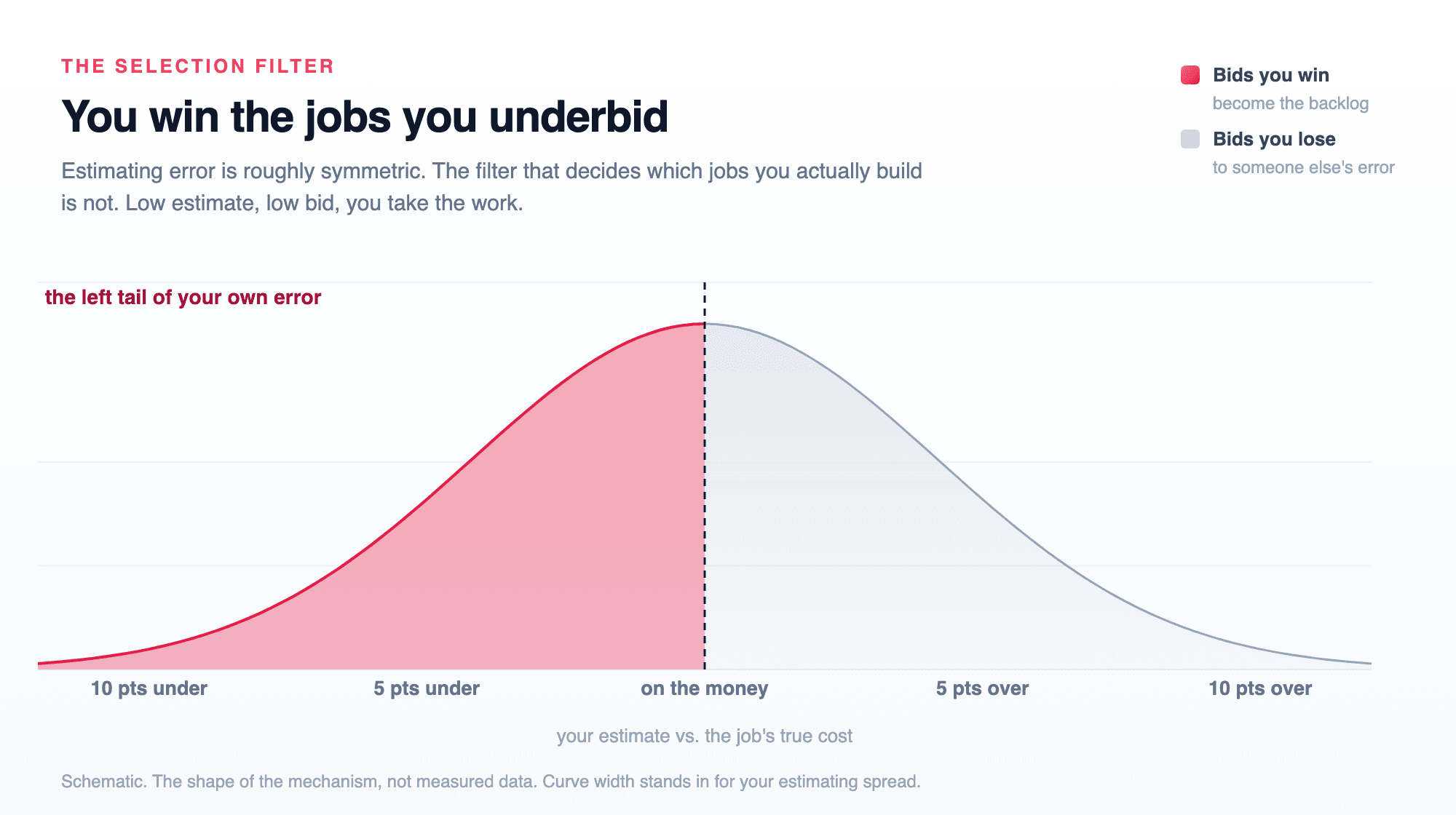
Spread sets the size of the loss. Estimates that land within a point or two give up almost nothing to selection. Estimates that swing ten points give up most of the difference, and then the crews get told to tighten up.
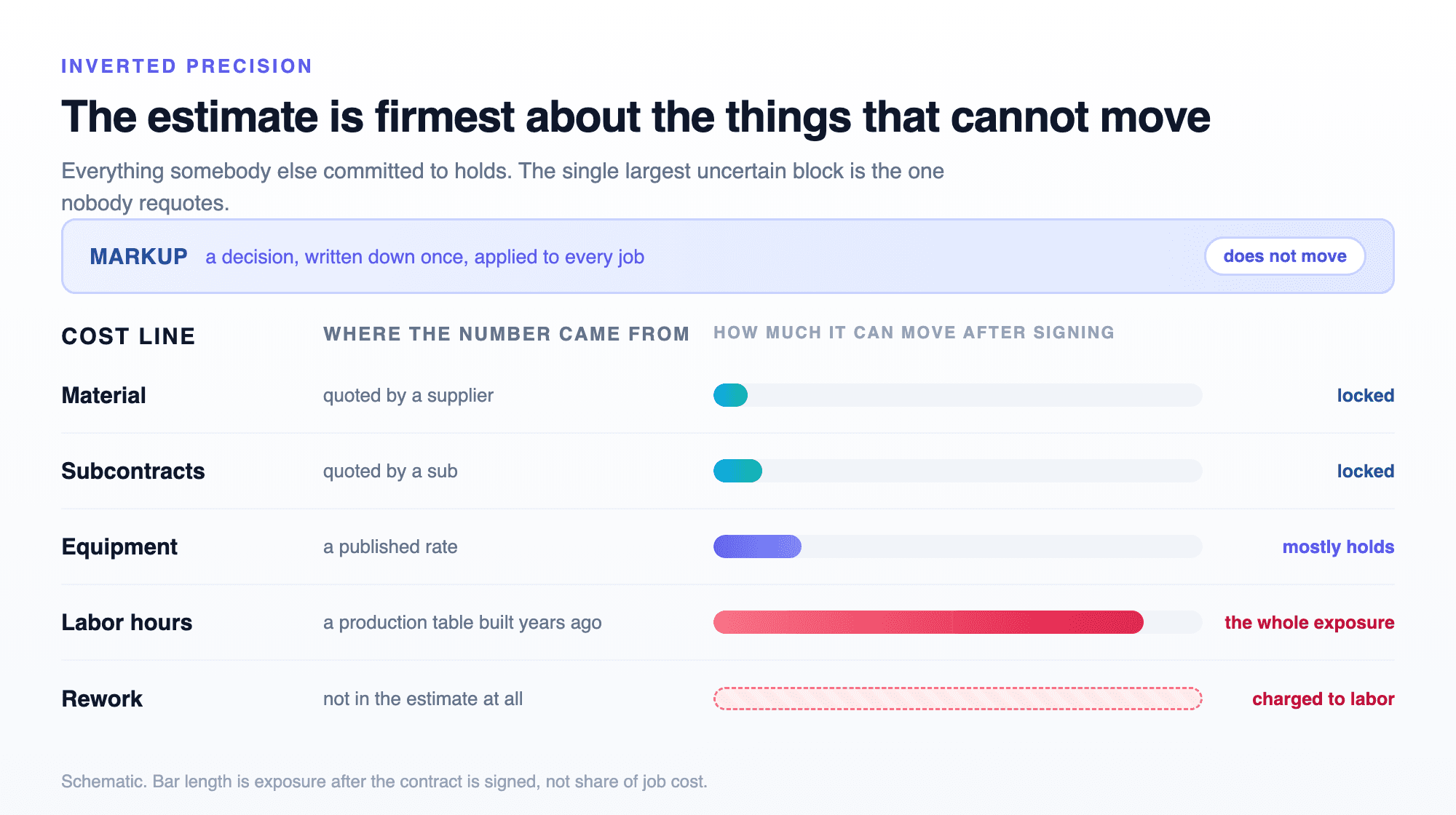
Construction estimates are firmest about what cannot move
Open any estimate and look at what is firm. Material is quoted. Subs are quoted. Equipment has a rate. Those numbers came out of somebody else’s commitment and they hold.
Labor came from a table. Hours per unit, built from jobs that closed in some earlier year, with a crew of different tenure, working different overtime, under a different superintendent. It is the largest uncertain block in the estimate, and the only one nobody requotes.
Rework compounds it, because rework has no line. No estimator prices the second attempt. When it happens it lands in labor, where it dissolves into a variance that gets explained as productivity. The rule never learns the category runs hot, because nothing separates work done once slowly from work done twice.
Mix drifts toward the category you price worst
The rule ages unevenly. It is close on the work you have always done and stale on the work you added after it was written. Occupied-building retrofit, phased turnover, anything with access constraints or wet work.
Pair that with selection and it compounds, because you are most likely to win in the category you price worst. So the underpriced bucket grows as a share of revenue without anyone deciding to grow it. Company margin drops while every estimator swears their numbers are the same as last year.
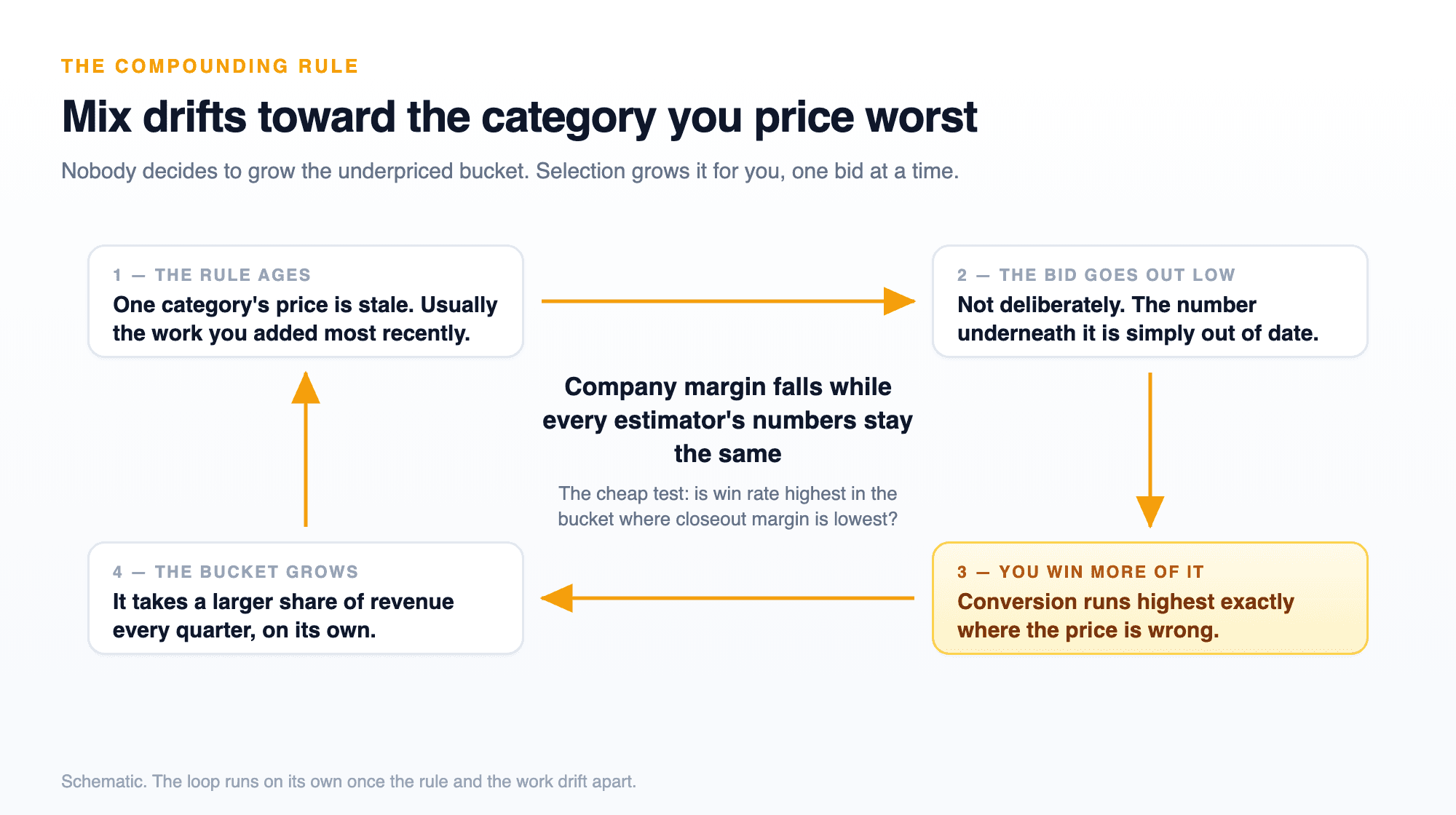
Win rate by category is the cheapest test available. If conversion runs materially higher in one bucket, check the price in that bucket before congratulating the sales team.
Contingency inside the budget is not a reserve
A number a project manager can see is a number a project manager can spend, and it goes at close to a 100% rate whether or not the risk it covered showed up. Held outside the job budget it does what it was meant to do. Inside it, it is three points of margin with a polite name.
What remeasuring actually means
None of this gets fixed by telling the field to be more careful. The field is not the variable. The estimating rule is, and a rule can be remeasured.
Four questions, asked per category rather than per company:
- What does as-built cost run against bid cost? Not the average. The distribution, including the tail.
- When was the labor production table last rebuilt from closed jobs, and on which jobs?
- What is the win rate in each bucket, and does the highest one line up with the lowest margin one?
- Who owns the markup, and what were they looking at when they set it?
That last one is the shortest conversation and the most revealing. Usually somebody set it, that person has since left, and it has been carried forward because it was already there.
The margin is not lost during construction. It is committed at bid, and the job just reports it.
If win rate is highest in the bucket where closeout margin is lowest, the rule is the variable. A 20-minute count will tell you whether that is happening in your last 50 jobs.